A while ago, I asked my girlfriend what programming language it did its work in. It said, "Ruby on Rails." Since it was working at that moment, I googled what that was. Soon after, I ended up on the "Machine code" Wikipedia page, more confused than ever. It compared this to telling me that it was an Impressionist painter, and ten minutes later seeing me on the Wikipedia page for "Shapes."
I've decided to take up a computer-learning journey. I'll hit it from a couple angles. There's learning HTML, CSS, Javascript, and Ruby. There's wading my way through using Linux for the first time. There's also regular old computer science, starting from "how does a circuit work." I learn better when I write stuff down, so here's where I'll do that.
Notes from AI Ethics by Mark Coeckelbergh
Great book! Very understandable for me, a computer illiterate. It also challenged my anti-AI bias in a couple of ways. It provides a quick history of AI and contemporary uses of it. Coeckelbergh goes from the symbolic AI and expert systems of the 80s to the connectionist neural networks of now. I had vibed out what AI, software, and algorithms were before, but this cleared it up:
AI is technologically simulated intelligence. While we usually mean human intelligence, that doesn't necessarily have to be the bar. AI is software, and software is made up of algorithms. Algorithms are a set of instructions that transform input data into output data.
Machine learning, what we think of as "AI" nowadays, is
"A machine or software that can automatically learn: not in the way humans learn, but based on a computational and statistical process. Feeding on data, learning algorithms can detect patterns or rules in the data and make predictions for future data."
Machine learning and the subfield deep learning often use neural networks. Neural networks are,
"...based on the idea that instead of representing higher cognitive functions, we need to build interconnected networks based on simple units. Proponents claim that this is similar to how the human brain works: cognition emerges from interactions between simple processing units, called “neurons” (which, however, are not like biological neurons). Many interconnected neurons are used."
A previously popular type of AI, symbolic AI, is often based on decision trees. Decision trees require that decisions or rules be made based on data ahead of time, and that those rules are coded into the system by programmers. With machine learning, the rules come from patterns recognized by the AI and are not coded ahead of time. They are unknown to us, a "black box."
AI is already used in many facets of our lives, including in ways we might not immediately expect. I knew about recommendation systems and video game NPCs, but I didn't know that autopilot and self-driving cars used AI too. There's also the different subfields of AI like, "machine learning, computer vision, natural language processing, expert systems, evolutionary computation, and so on." These subfields interact with these facets in various ways that understandably aren't covered in full.
Coeckelbergh separates the actual issues with AI from the "Frankenstein complex" that imagines every AI to be a supergenius Terminator-in-waiting. In reality,
"There seems to be a real risk that in the near future the systems will not be smart enough and that we will insufficiently understand their ethical and societal implications and nevertheless use them widely."
There's also the ethical points of how much moral agency AI has, whether we should be the ones to prescribe it moral status at all, how good AI is at simulating human connection, how low the bar is for using AI maliciously, the inscrutability of AI to the public, explainability, and energy consumption.
I learned about Bostrom's paperclip maximizer and Searle's Chinese room thought experiments from this book too! More to read for later :]
Linux Diary
April 24th, 2026
SAUR. I installed Linux Mint, because Windows is awful and I've been complaining about it for years. My girlfriend threw it onto a USB and gave it to me, and I installed it in an afternoon. As I'm pretty computer-illiterate, I considered this a good sign. Things have been ok since. Fun, even. I forgot what it was like to be Excited By Computer. Linux gave me that feeling back :]
However, I've had some problems. Most of them are my fault and I was able to fix, but some I'm still fixing. The stuff I've fixed/learned:
Wine wasn't showing up even though I'd installed it 300 times. Turns out Wine can only be run from terminal, not launched like regular software.
Learned what an AppImage file is and tried to learn how to pin these files to my panel. You can do it, but it's not immediately easy, so I just moved the file over to my desktop and made them shortcuts lol
Changed my boot screen and then changed it back, because it turns out "boot screen" was not the thing I was trying to change
Learned what my friend meant when they corrected me on Linux not being an operating system. It's a kernel! A kernel is the part of an operating system that has power over every other part. Operating systems are built around this kernel. You can update the kernel on its own if you want, by either doing it through your update manager or going to the website if you want the newest thing. More on that <a href="https://www.baeldung.com/linux/kernel-update-latest">here.</a>
Stuff I haven't fixed/learned yet:
One of my game engines is a .sh file and the other just says x-executable. I think I understand what a .sh file is??? But clearly not well enough
May 25th, 2026
Bluetooth issue fixed itself recently, but not before I devoted a few futile hours over the course of months to it before giving up. Whenever I connected a specific mouse, the mouse would work, but only until my computer fell asleep. When I tried to reconnect, I got the error:
le-connection-abort-by-local
Not only would the mouse not connect, but all bluetooth would be nonfunctional until I restarted the computer.
I looked up the error. That brought me here. Ran hciconfig (which, by the way, is a reference to the host-controller interfacing relationship between a pc/phone and bluetooth microchip). Got back my bluetooth driver. linux-hardware.org says it's supported by kernel versions 6.9 and newer--mine was a 6.8-something. Verified by clicking on the "Source" for my kernel versions, which is how I ended up at the Linux Bluetooth driver page. Sent a screenshot to the group chat, along with this:
They said this was even more impressive than my Ruby on Rails Wikipedia adventure.
I looked into installing the newest kernel, but it seemed sort of scary so I didn't do it. Installed BlueZ, no difference. Tried to find other examples of this happening. I didn't feel like reinstalling Mint, and while I was able to get to BIOS by spamming F2 at boot, I couldn't find a Bluetooth option anywhere??? I checked every option under every submenu and it was not there. Mama raised a quitter, so I gave up there. I didn't want to waste any more time when I had a perfectly fine wired mouse.
A couple months and a kernel update later, I plugged in a bluetooth receiver for another mouse and, on a whim tried to connect the mouse from before to it. It worked! My hands are much less achy now.
Fun Stuff
*all of this was shown to me by my girlfriend and/or friends
The XZ Backdoor Hack. Guy notices a very small performance issue with Debian, upends the carefully-cultivated plan taking place over years that would've been disastrous for users.
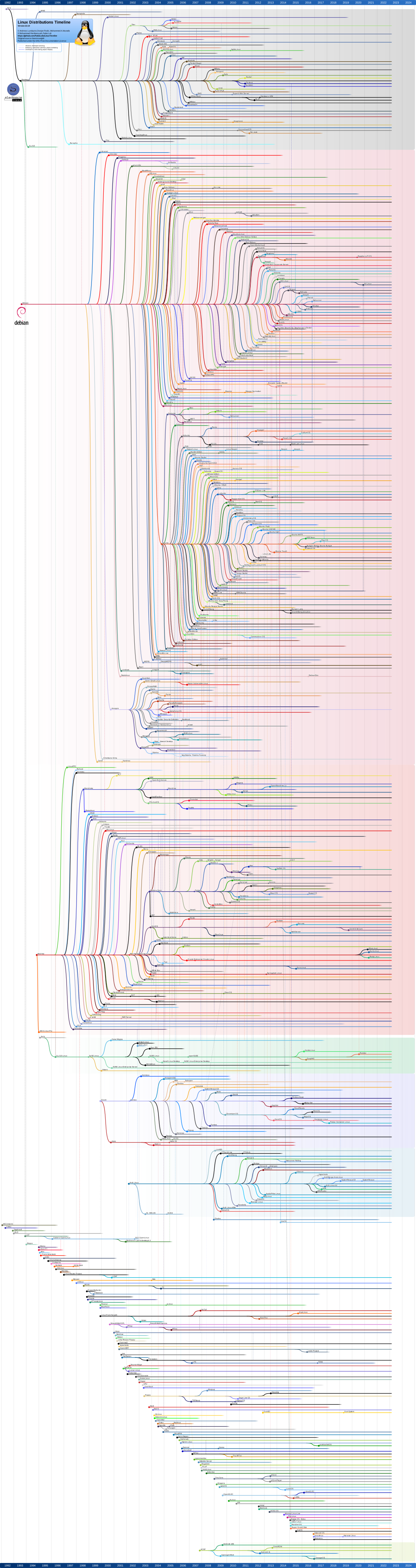
Evil Map was shown to me when I started getting into Linux and learning that it was not, in fact, a sole operating system but a family. In the words of Jacob Geller, "this clears everything up!!!"
Origins of the GNU/Linux copypasta. According to Wikipedia fumbling, Richard Stallman's project GNU tried to make their own free and open-source operating system. They got most of the way there, but struggled with making the kernel work. Linux Torvalds had separately built his own kernel based on Unix. Multiple people at GNU ported in his kernel and boom, Linux as we know it. Stallman is stalwart about referring to Linux as GNU/Linux, hence the copypasta. I don't really know enough about intellectual property or whatever to make a judgement
Richard Stallman is also famous for, unprompted, eating something from his foot once. The video is age-restricted on Youtube.